
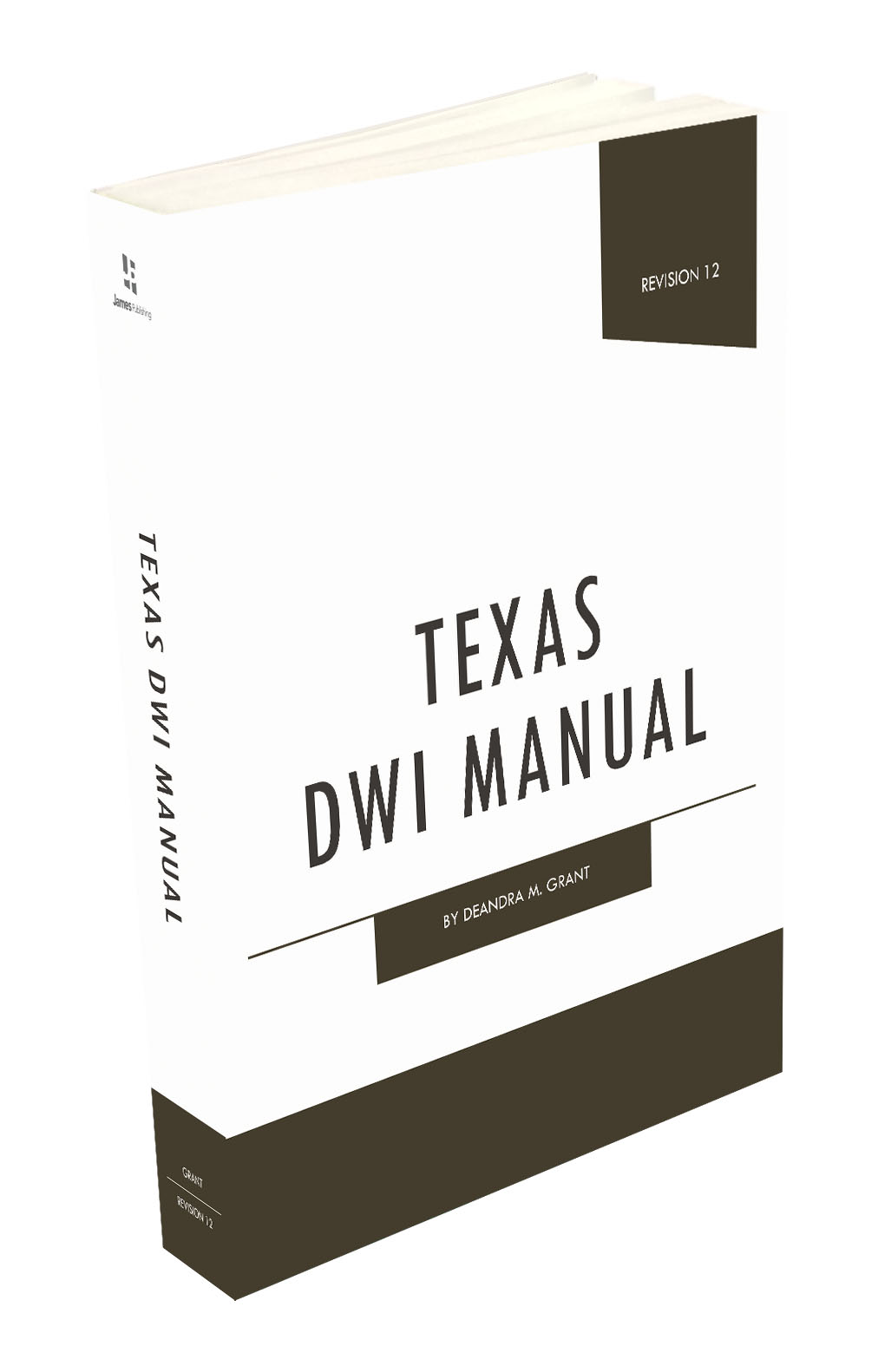
Description
A comprehensive guide to representing DWI clients in Texas
Because a conviction is so costly, a plea to a Texas DWI should be a last resort. To provide the defense your DWI clients need and deserve, you must be prepared to confront the State’s witnesses at trial. Cross-examination of the State’s witnesses is probably the most difficult, yet most crucial aspect of winning a DWI trial. In Texas DWI Manual, successful DWI attorney Deandra M. Grant offers the tools you need to take the DWI case from inception through trial and beyond. This valuable guide includes:
- Hundreds of trial-tested cross-examination questions
- Over 80 forms and numerous practice tips
- Clear explanations of the law and the science
- Tactics for discrediting SFSTs
- Step-by-step guidance for trying breath and blood cases.
DWI defense is one of the most challenging and technical areas of criminal law. To establish a successful DWI practice, you must have a firm grasp of the law as well as grounding in the underlying science. Texas DWI Manual brings these two essential elements—the law and the science—together in one indispensable resource. With hundreds of hours invested in DWI defense training and decades of experience representing DWI defendants, author Deandra M. Grant shares with you her most effective strategies. Let her walk you through each phase of the Texas DWI case from investigation and discovery through the trial and expunction of your client’s criminal record. 20 practice tips from the book These 20 tips offer you a small preview of the innumerable ways that Texas DWI Manual will prepare you to provide your DWI clients with a robust defense: Field Sobriety Tests
- What to watch for in administration of OLS. Does the officer tell your client that if she puts her foot down she should pick it back up and continue the test? That is not part of the instructions for the test. . . . [§5:83]
- Deviations from NHSTA procedures. When challenging the HGN test or any other field sobriety test that uses an NHTSA standard, ask the officer to agree that NHTSA believes that its procedures should be followed as given. If the officer does not agree, point out the following section in the NHTSA manual. . . . [§5:103]
Breath Test Cases
- Object to PBT results on video. It is critical to look for whether the results are either stated aloud or flashed before the video camera. The results are inadmissible at trial, but will be admitted if you do not object before the video is admitted and published. [§2:64]
- A “machine,” not an “instrument.” Technical Supervisors are taught to continually refer to the 5000EN as an “instrument” as opposed to “machine” to give it more credibility. “Machine” implies something that might break. Don’t fall into the trap of calling this an instrument. Always call it what it is—a machine. [§6:91]
- Blood or breath—don’t ask which is more accurate. Do not ask if the Technical Supervisor thinks blood is a more accurate way to test for a person’s alcohol concentration than a breath test. Most will say no. However, your JURORS will likely think that blood is more accurate. Save this argument for closing. [§6:93]
- Make an open records request. Send an open records request to your Technical Supervisor requesting copies of any letters that have been sent to the DA’s Office concerning machines that have been found to be malfunctioning or test results they have refused to sponsor. . . . [§6:95]
- Notify supervisor of intention to reference scientific materials. When asked about a particular study or opinion, technical supervisors will often deny that they have read it or know anything about it. As a result, I give notice to the Technical Supervisor of my intention to reference certain materials during cross-examination. . . . This should prevent the technical supervisor from claiming that he or she does not know anything about a particular issue. [§6:110]
- When the second test is lower. Always ask the Technical Supervisor if that means that your client’s alcohol concentration was declining while he was taking the test. For example, if the first blow is .093 and the second is .086, a jury may believe that your client was in the elimination stage. You need to have the Technical Supervisor testify that a person can not eliminate that much alcohol in 2 minutes. [§6:162]
Blood Test Cases
- Investigate sanitation if client’s blood was drawn in jail. You may have an argument that the specimen was not drawn in a sanitary place. . . . You may want to obtain an inspection report, cleaning logs, and the type of cleaner/disinfectant used in the area of the jail you are dealing with by using a Public Information Request. . . . [§7:72]
- Watch out for a “short draw.” If the blood draw is “short” (i.e., less than 9 ml), it might be an indication that the vacuum had been compromised. . . . A compromised vacuum seal may allow contaminants to be introduced into the tube. [§7:91]
- Make the State produce an expert. Prosecutors typically do not understand the difference between a forensically tested whole blood test result and a hospital lab enzymatic blood test screening. They may attempt to offer the hospital result with no conversion. . . .You will need to argue that they should be required to have a witness capable of converting the result to a whole blood alcohol concentration. . . . [§7:101]
- False positives. The kits used in the hospital labs for enzymatic testing of blood plasma alcohol levels are prone to false positives. . . . A common interferent is lactic acid which can enter the blood due to muscle or organ injury or from fluids introduced via IV. [§7:101]
Retrograde Extrapolation
- Recognized authorities. In my experience, Technical Supervisors in Texas will recognize AW Jones, Kurt Dubowski and the book, Gariott’s Medico-Legal Aspects of Alcohol, as authorities. I like to get this out early so that I can keep referring to them as “your teacher, Dr. Dubowski” or “your teacher, Dr. Jones.” [§8:02]
- Ask about retrograde extrapolation calculation in advance. If the Technical Supervisor has done the calculation for the State, I ask the Supervisor to provide it to me so I’ll know in advance what retrograde range will be provided to the jury. [§8:31]
ALR Hearings
- If your client took a blood test. The DIC 25 Notice of Suspension will be mailed to the client only if the results of the blood test are .08 or higher. Do not send in a request for hearing until DPS sends this letter. . . . It is a request for nothing if DPS does not show that your client is entitled to a hearing. [§1:40]
- Getting a hearing transcript. My office e-mails the clerk of our local SOAH office a request for the hearing transcript and the clerk then emails us a “.wav” file. I obtain my transcripts in this manner because it ensures me that no one other than my office [e.g., the DA] will get a copy of our transcript. [§3:152]
Sentencing Strategies
- File a Motion to Remove Interlock. If your client has successfully completed 50% of his probationary term, he is eligible to request that the judge remove the interlock requirement from his probation conditions. . . . [§10:41]
- Remind judge to consider length of license suspension. Judges seldom supply DPS with their opinion on a license suspension, and DPS simply applies the maximum period allowed by law. Always request that the judge consider the facts of your case and the full range of suspension available. . . . It is not difficult to prevent maximum license suspensions in almost all cases. [§10:50]
DWI Expunctions
- Expunging ALR and ODL records. Be sure to identify your client’s ALR and ODL cause numbers in your petition if you want to have these records destroyed. If this is the case, you will have to notify the appropriate agencies. . . . [§12:20]
- Informing non-state government agencies. Texas courts are not required to notify non-state government agencies of an expunction. . . .The best approach to ensure these agencies are notified is to place the burden on Texas DPS to notify the private entities to which DPS sells its arrest records that an expunction has taken place. You may do this by. . . . [§12:45]
REVISION 12 HIGHLIGHTS
DWI defense is one of the most challenging and technical areas of criminal law. Author Deandra Grant and her collaborators share with you their most effective strategies. This edition brings you:
NEW AND EXPANDED TOPCIS:
- Discovery and the Michael Morton and Richard Miles Acts. §2:31
- AI Assistance with a large volume of videos. §2:52
- NHTSA 2025 SFST curriculum update. §5:23
- GERD & breath alcohol testing—informative article! §6:13
- Blood collection tubes and contamination issues—extensive new coverage! §7:90
- Headspace gas chromatography with flame Ionization detector (GC-FID)—new detailed discussion! §7:100
- Bariatric surgery and factors affecting absorption. §8:11
- Pharmacodynamics—new! §9:00
- Pharmacokinetics—new! §9:001
- Top DUID drugs by category as of 2024. §9:002
- Key cases on boat stops. §9B:1
- Understanding alcohol monitoring devices—informative article! §15:2
- Unlawful inventory searches. §17:37
NEW AND REVISED FORMS:
- Form 1-2 Fee Agreement – Initial Representation.
- Form 1-2c Fee Agreement – Trial Preparation.
- Form 1-2d Fee Agreement – Motions Contract. New!
- Form 2-11b Michael Morton Act Request for Discovery – Filing. New!
- Form 2-12 Motion to Exclude Evidence for Violation of MMA. New!
- Form 2-13 Richard Miles Act Request for Compliance. New!
AND MORE!
ABBREVIATED TABLE OF CONTENTS
I. Taking the Case
CHAPTER 1. Effective DWI Representation and Client Communications
CHAPTER 2. Investigation of the Case and DWI Discovery
II. Driver’s License Issues
CHAPTER 3. Administrative Driver’s License Revocation Hearings
CHAPTER 4. Occupational Driver’s License
III. Defending the Case
CHAPTER 5. Standardized Field Sobriety Tests and Their Use in Trial
CHAPTER 6. The Breath Test Case
CHAPTER 7. The Blood Alcohol Test Case
CHAPTER 8. Retrograde Extrapolation
CHAPTER 9. Driving Under the Influence of Drugs
CHAPTER 10. Punishment Strategies
CHAPTER 11. Error Preservation and Appeal
CHAPTER 12. DWI Expunctions
CHAPTER 12A. DWI Nondisclosure Orders
IV. Legal Principles
CHAPTER 13. The Elements of DWI
CHAPTER 14. Intoxication Offenses and Punishment
CHAPTER 15. Bond & Jail Release Considerations
CHAPTER 16. Charging Instruments
INDEX
ABOUT THE AUTHOR
AV-rated attorney Deandra Grant is the Managing Partner of Deandra Grant Law. Her practice is focused on DWI and criminal defense in Texas. A graduate of Trinity University in San Antonio, TX, and Southern Methodist University’s School of Law, she is a national speaker on DWI law and science and the co-author of Texas DWI: Truth & Consequences and Surviving Your Texas DWI. Deandra is a Standardized Field Sobriety Testing Instructor and has completed the Drug Recognition Overview course. She was the first attorney in Texas to pass the Forensic Sobriety Assessment Certification exam. In addition, she has completed coursework in DWI forensic blood and urine testing and was trained as an operator and maintenance technician of the Intoxilyzer 5000. Deandra has certificates in Forensic Chromatography: Theory & Practice (2011 & 2015), Forensic Analysis of Solid Drugs (2014) and Forensic Principles of DUID (2015) issued by Axion Labs and the American Chemical Society. In 2015, Deandra earned the distinction of being named an ACS-CHAL Forensic Lawyer-Scientist.
Deandra is a member of the Texas Criminal Defense Lawyers Association (Board Member 2011-2016), the Collin County Criminal Defense Lawyers Association, the Denton County Criminal Defense Lawyers Association, the Tarrant County Criminal Defense Lawyers Association, the Dallas Bar Association, the Dallas Women Lawyers Association, the Dallas Criminal Defense Lawyers Association (Board Member 2007-2021, President 2022), the Ohio Association of Criminal Defense Lawyers and the South Carolina Association of Criminal Defense Lawyers. In addition, Deandra is a Charter Member and President Emeritus of the DUI Defense Lawyers Association. She is also a member of the American Chemical Society and the American Academy of Forensic Sciences.
D Magazine has named Deandra to its list of Best Women Lawyers and Best Lawyers in Dallas. She’s been named a “Texas Super Lawyer” 13 times and one of Texas’ Top-Rated Lawyers. Best Lawyers in Dallas named her one of the Top 10 DWI Lawyers in Dallas. Deandra completed a Graduate Certificate in Forensic Toxicology from the University of Florida’s College of Veterinary Medicine and a Master’s Degree in Pharmaceutical Science – Concentration in Forensic Science from the University of Florida’s College of Pharmacy in 2016. In 2019 Deandra joined the faculty at Axion Analytical Labs as an Assistant Chromatography Instructor for the American Chemical Society and has served as a faculty member for the Borkenstein Drug Course.
Deandra Grant Law has offices in Dallas, Allen, Denton, Fort Worth, Waco, Austin, and Rockwall and can be contacted at:
Deandra Grant Law
3300 Oak Lawn, Ste. 700
Dallas, TX 75219
(972) 943-8500
[email protected]
DeandraGrantLaw.com


What others are saying
There are no contributions yet.